The depth you expect.
From 92 kHz vibration to APC control action — one stack, one data fabric. Spectra, RUL, advisor. Not «vibration as a cloud service» — a full L0–L3 stack you can deploy on your own hardware.
One pulse — four layers.
Every layer is a separate product with open documentation and standard protocols. Take the whole stack or individual parts — standards first.
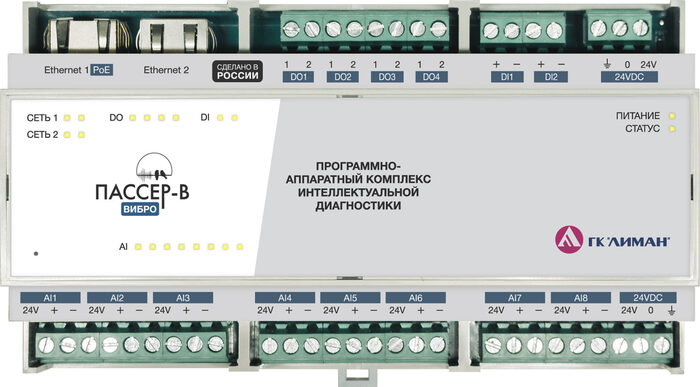
8-channel IEPE acquisition at 92 kHz, 24-bit. MCSA on motor current. The asset's stethoscope.
FFT, envelope, RMS, ML inference at the edge. IEC 61499 (4diac). The cardiogram, in real time.
Asset twin, RUL, operator advisor, control action. The therapist plus the prescription.
The cardiologist's dashboard — for the owner, the CFO, the engineer. Software registry №15057.
Where the sensors plug in.
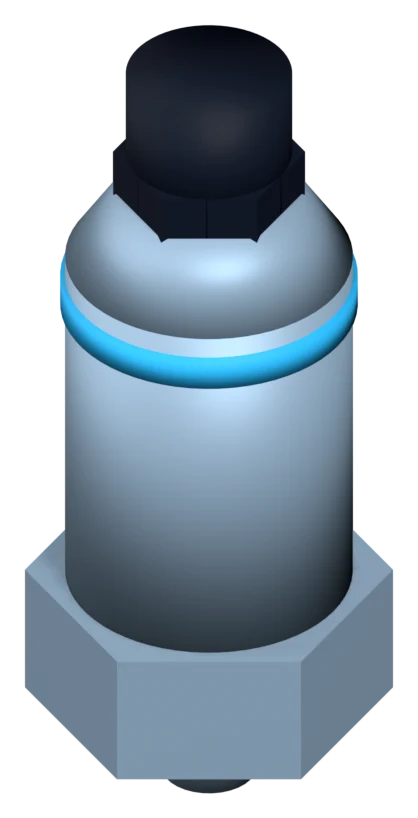
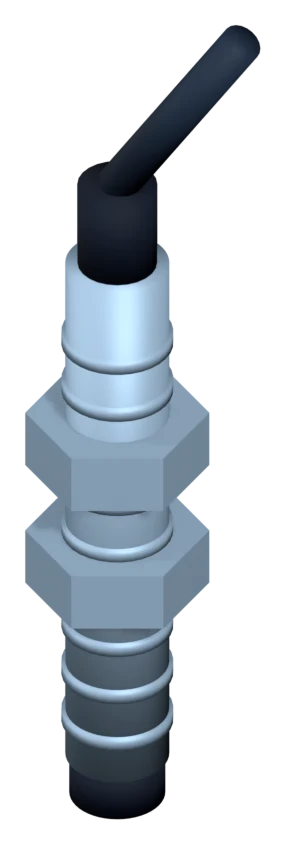
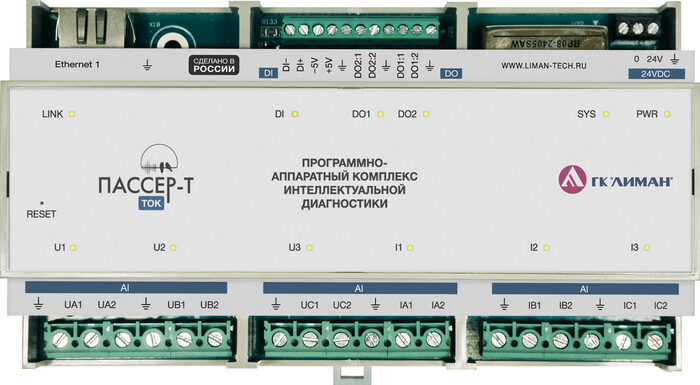
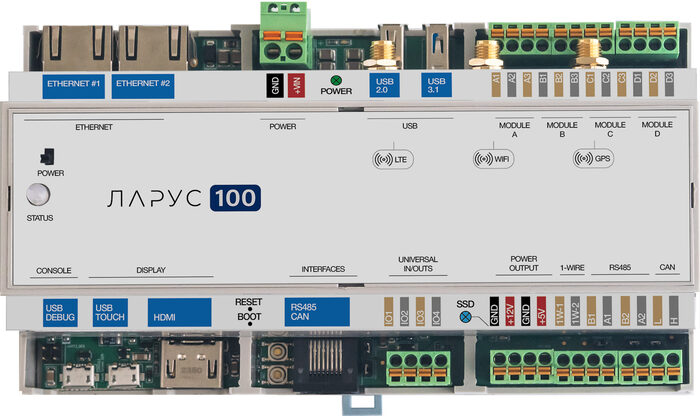
Vibration and current go into Passer controllers as raw streams. Everything else — sensors, PLCs, meters — Larus ingests directly over Modbus, OPC UA and 4–20 mA. No aggregation before diagnostics: spectra are computed on the full signal.
A bearing defect — months before failure.
Envelope analysis isolates the rolling-element frequencies — BPFO, BPFI, BSF, FTF — long before the overall ISO 10816 level leaves zone A/B.
- Spectra and envelope are computed on Larus — next to the equipment, on the full signal up to 92 kHz
- ML classifiers per failure class + remaining useful life (RUL) from the defect trend
- Combined vibration + current diagnostics: Passer-V and Passer-T synchronised over PTP (IEEE 1588)
- The output is not an alarm — it is a prioritised work order in your CMMS
This is what a bearing defect looks like months before failure: an even row of rolling-frequency harmonics in the envelope spectrum.
Stability first. Optimisation next.
Predictive diagnostics and condition-based maintenance remove unplanned stops — that lifts the Availability term of OEE. On stable equipment the second level kicks in: APC — MPC, soft-sensors and ML models hold the optimal regime and work on Performance and Quality. Same L0–L3 stack, same data fabric: the spectra and current signatures we diagnose with become inputs for the control models. APC-readiness is what level one delivers.
Predictive diagnostics + RUL + condition-based work orders instead of calendar PMs.
MPC/RTO holds throughput at the active constraint — not at a «safe» distance below it.
Soft-sensors close the lab-assay lag and cut variability — the process runs closer to spec.
Sense / Decide / Act — how we do it.
- Passer-V — 8 IEPE channels, up to 92 kHz, 24-bit
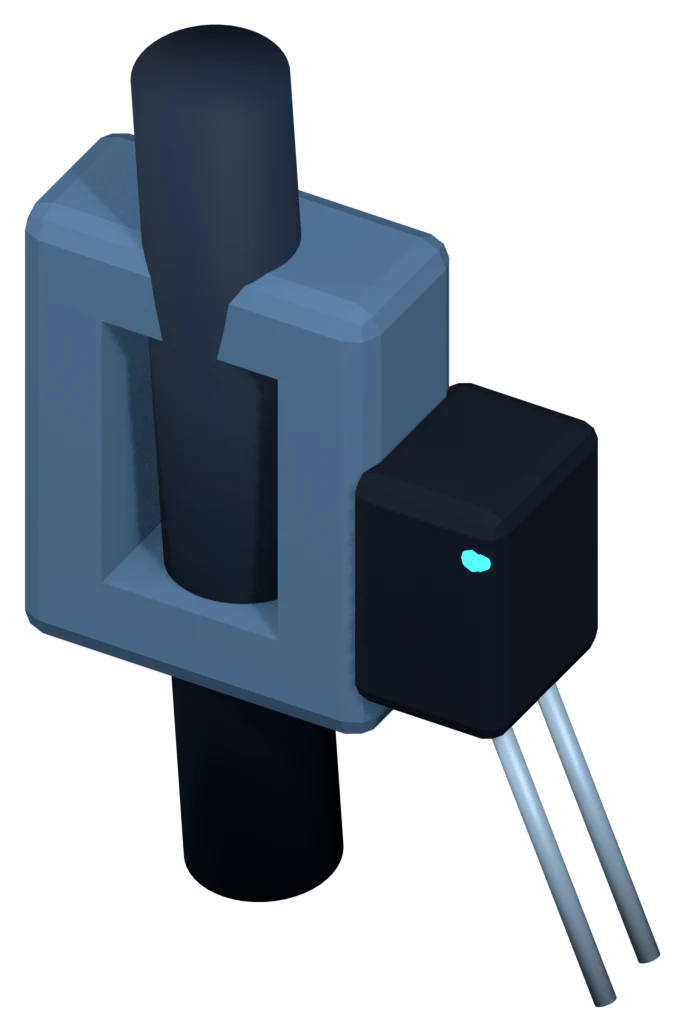
- Passer-T — motor-current signature analysis (MCSA)
- Raw stream over Ethernet to Larus — no losses, no aggregation
- Larus-10 — edge diagnostics for pilots
- Larus-100 — IEC 61499 (4diac), edge automation
- OPC UA, MQTT Sparkplug, AAS — open standards
- Cloud · self-hosted · on-appliance — your call
- Strix Connect — free for the first 100 tags
Hardware — key characteristics.
Full specifications and wiring schemes live on the product pages and in the documentation.
- Channels
- 8 IEPE / ICP, simultaneous
- Sampling rate
- up to 92 kHz / channel
- Resolution
- 24-bit ADC
- Sync
- PTP (IEEE 1588) across multiple Passer-V units
- Operating temp
- −40…+70 °C
- Channels
- 3 phase current + 3 phase voltage, simultaneous
- Current input
- via clamp-on or split-core CT (1 A / 5 A secondary)
- Sampling rate
- up to 50 kHz / channel
- Sync
- PTP (IEEE 1588), pairs with Passer-V for combined vibration + current diagnostics
- Compute
- Rockchip RK3568J, 4-core ARM Cortex-A55
- Diagnostics on board
- FFT, envelope, RMS / Peak / Crest factor, bearing-fault frequencies, ML inference
- Output protocols
- OPC UA, MQTT (Sparkplug B), Kafka, REST
- Network
- Ethernet ×2 (1 Gbps) / Wi-Fi (optional) / 4G (optional)
- Edge runtime
- Eclipse 4diac (IEC 61499)
- Compute
- Rockchip RK3568J, 4-core ARM Cortex-A55
- Connectivity
- Ethernet ×2 (1 Gbps) / Wi-Fi (optional) / 4G (optional)
Open documentation — before you ever talk to sales.
Wiring schemes, configuration, protocols, API — all published at docs.liman-tech.ru.
Vibration controller: wiring, configuration, raw streaming
Current controller: CTs, tapping schemes, MCSA
Edge gateways: diagnostics, IEC 61499, protocols
Platform: data fabric, AAS twin, applications
HMI: dashboards, role model, mobile client
A diagnostic day at your site.
We bring a Passer + Larus kit, hook up to 2–3 machines, and show you the spectra and first findings by the end of the day.