Energy Efficiency
Cut your plant's energy bill — metering, specific-consumption norms and verified savings. From an energy audit to energy performance contracting (ESCO): pay out of what you save, with no upfront investment.
This mix delivers the most on the industry's key process stages. Details in the cards below.
These are typical industry ranges; your actual potential is shown by an energy audit and an on-site baseline.
Where the losses hide — area by area
Energy losses stay invisible until you have instrument-level metering: motors running flat out behind a half-closed damper, compressed-air leaks, power-factor penalties, heat going up the stack. We make the losses measurable — keep a finger on the pulse of your asset’s energy flow.
Compressed air
Steam and boiler houses
Electric arc furnaces (EAF) and reheat furnaces — the flagship
Reactive power and networks
Metering and baselines — the foundation of it all
Where combined methods multiply the effect
Three rollout levels — pick by maturity
Energy audit and metering
Make the losses visible
Baselining and energy management
Consumption norms, ISO 50001 / Federal Law 261-FZ
Turnkey energy performance contracting (ESCO)
Savings with no investment
Where this section sits on the site map. Power generation is about how energy is produced: thermal and hydro plants, turbines and boilers. This section is about how to stop overpaying for it on the shop floor: metering, baselining and verified savings at any plant. For diagnostics of metallurgical equipment (vibration and current on furnaces, rolling mills, cranes), see the Metallurgy section — there the same arc furnace is viewed from the other side: how much energy it spends per tonne of steel, rather than how its bearings are feeling.
Two metallurgy archetypes. Electric steel (arc furnace) and the integrated steel mill — we cover both. An integrated mill has no arc furnaces: there we baseline blast-furnace blowing, oxygen, sinter, rolling-mill reheat furnaces and on-site generation on blast-furnace gas — right down to shaving demand peaks, which are billed separately from kilowatt-hours.
Our principle: measure, baseline, verify the savings. We don’t sell hardware for its own sake — power equipment (variable-frequency drives, capacitor banks, heat-recovery units) is specified and supplied as a subcontract, while we stay accountable for a measurable result: the rationale, the management and the verification of savings under the international M&V methodology (ISO 50015). That’s why energy performance contracting, where our fee depends on your savings, is a natural way for us to work — not a marketing line.
Keep a finger on the pulse of your asset’s energy flow
Energy is the most manageable cost line at a plant — but you can only manage what you measure continuously. From the meter to the executive screen — four steps.
Meters — the pulse monitor
Electricity meters, heat sensors and flow meters for steam, gas and air. Passer-T on the motor supply lines meters energy and watches drive condition at the same time. Connection — with no production stoppage.
Data collection — Larus
Larus polls the meters over existing communication lines, buffers and forwards the data. We do not replace your existing commercial metering (utility metering system) — we connect it as one of the sources.
Strix — the cardiogram
It compiles the energy balance, computes baselines and specific consumption, and compares actual against the norm by shop and shift. Overruns show up the day they happen, not in the annual report.
Energy engineer’s screen — the dashboard
LimanISU: the chief energy engineer’s workstation and an executive summary screen, with automatic reports for ISO 50001 and the Russian energy-efficiency law (261-FZ). Everything runs on-premise; the software is in the Russian software registry.
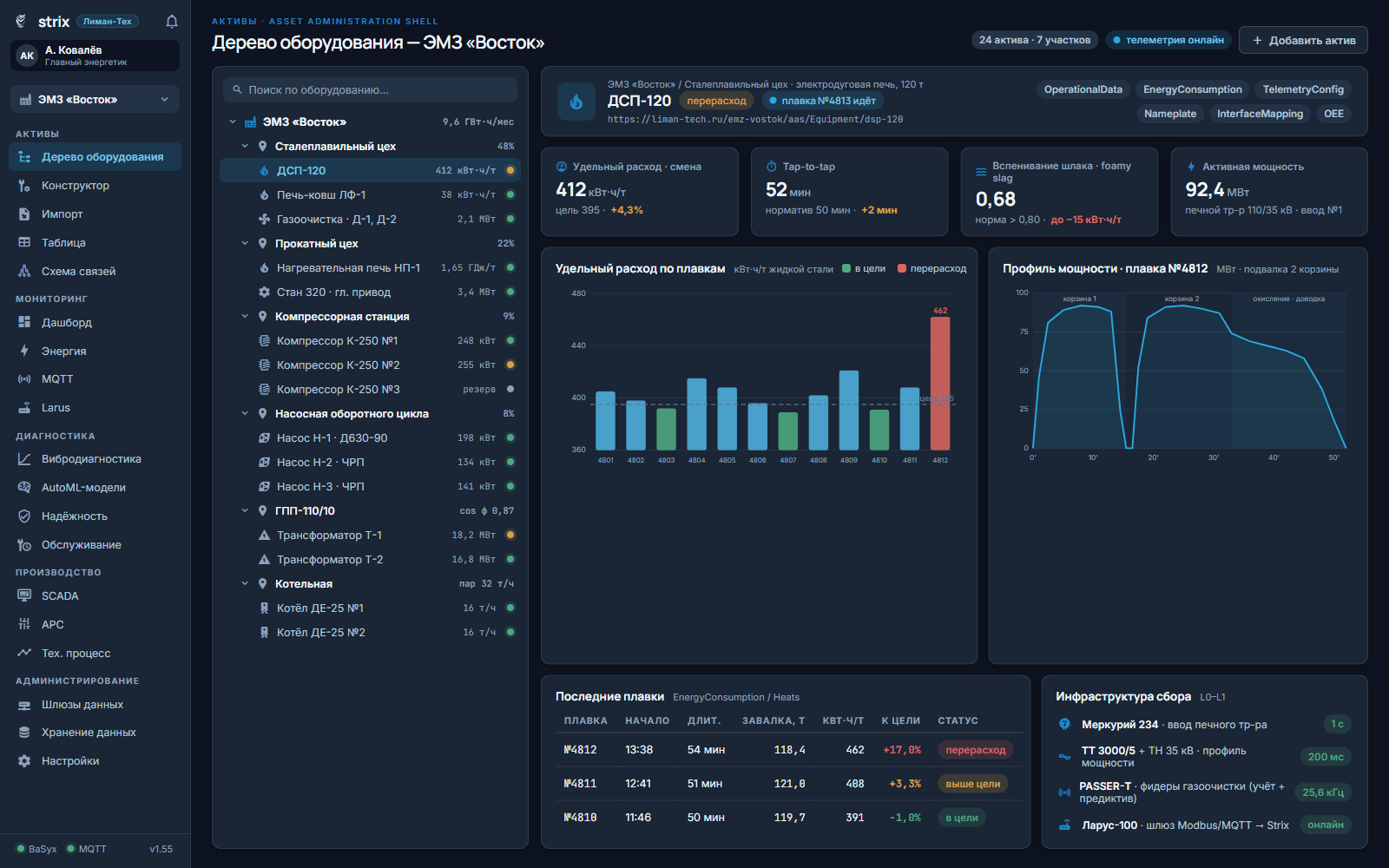
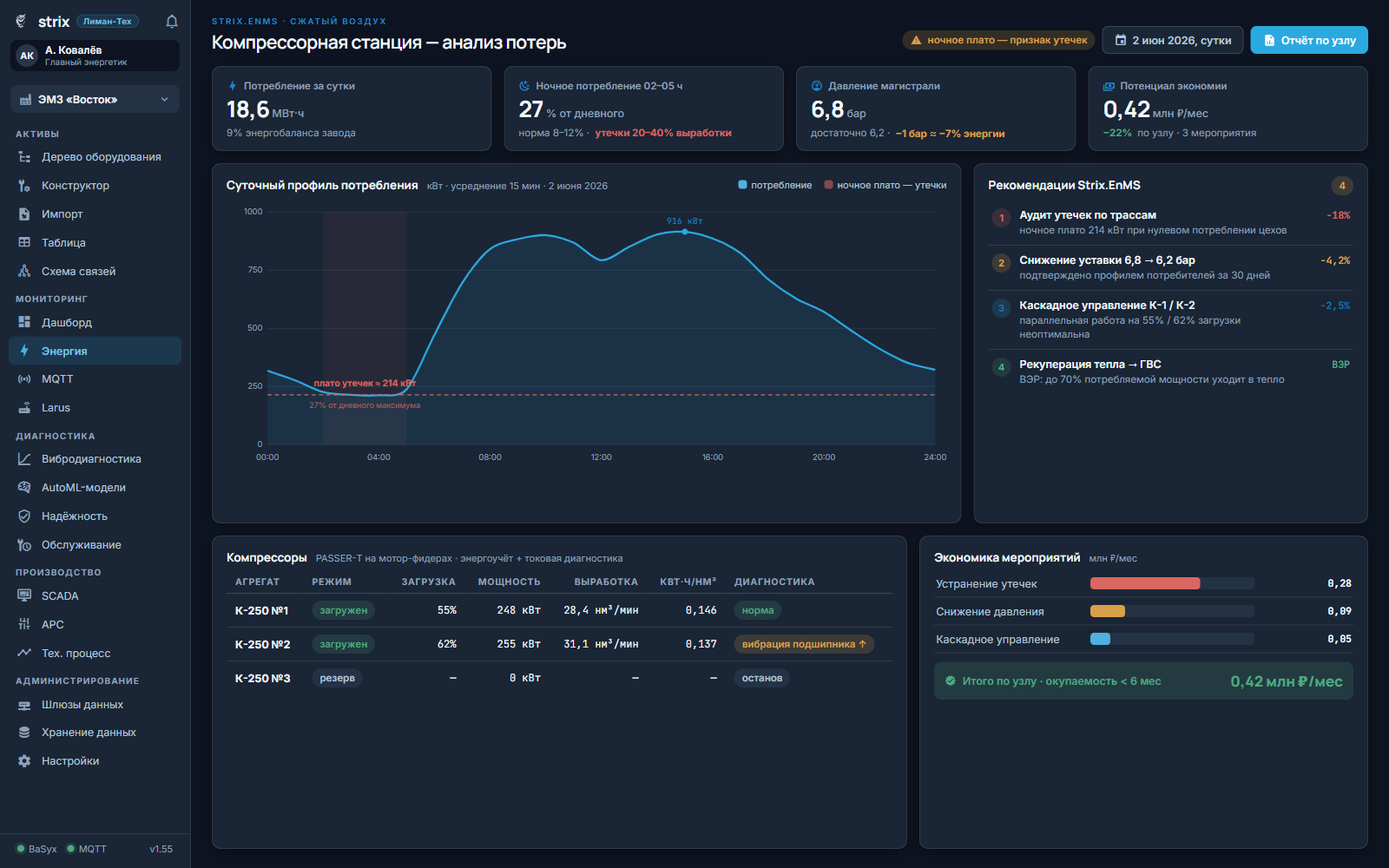
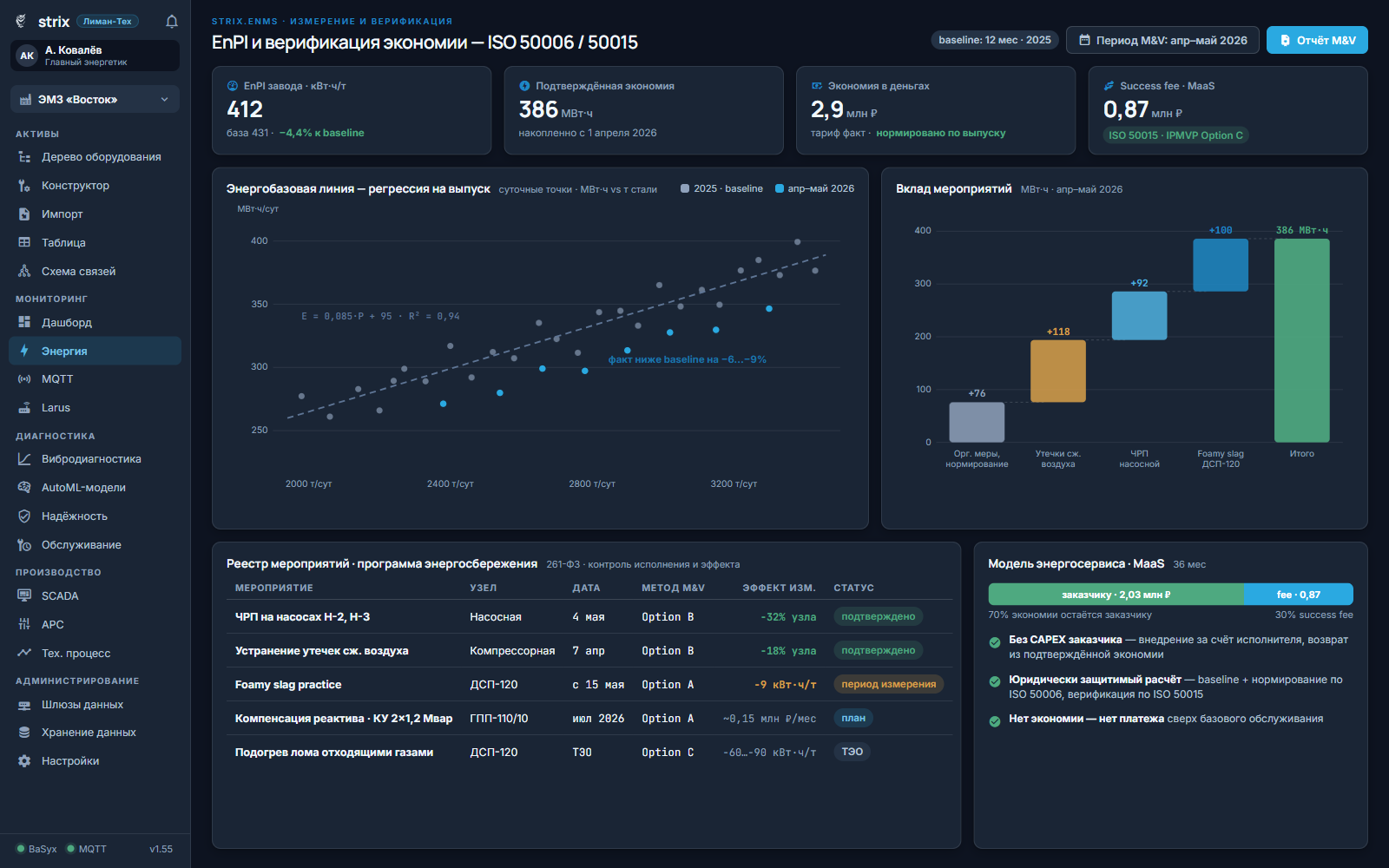
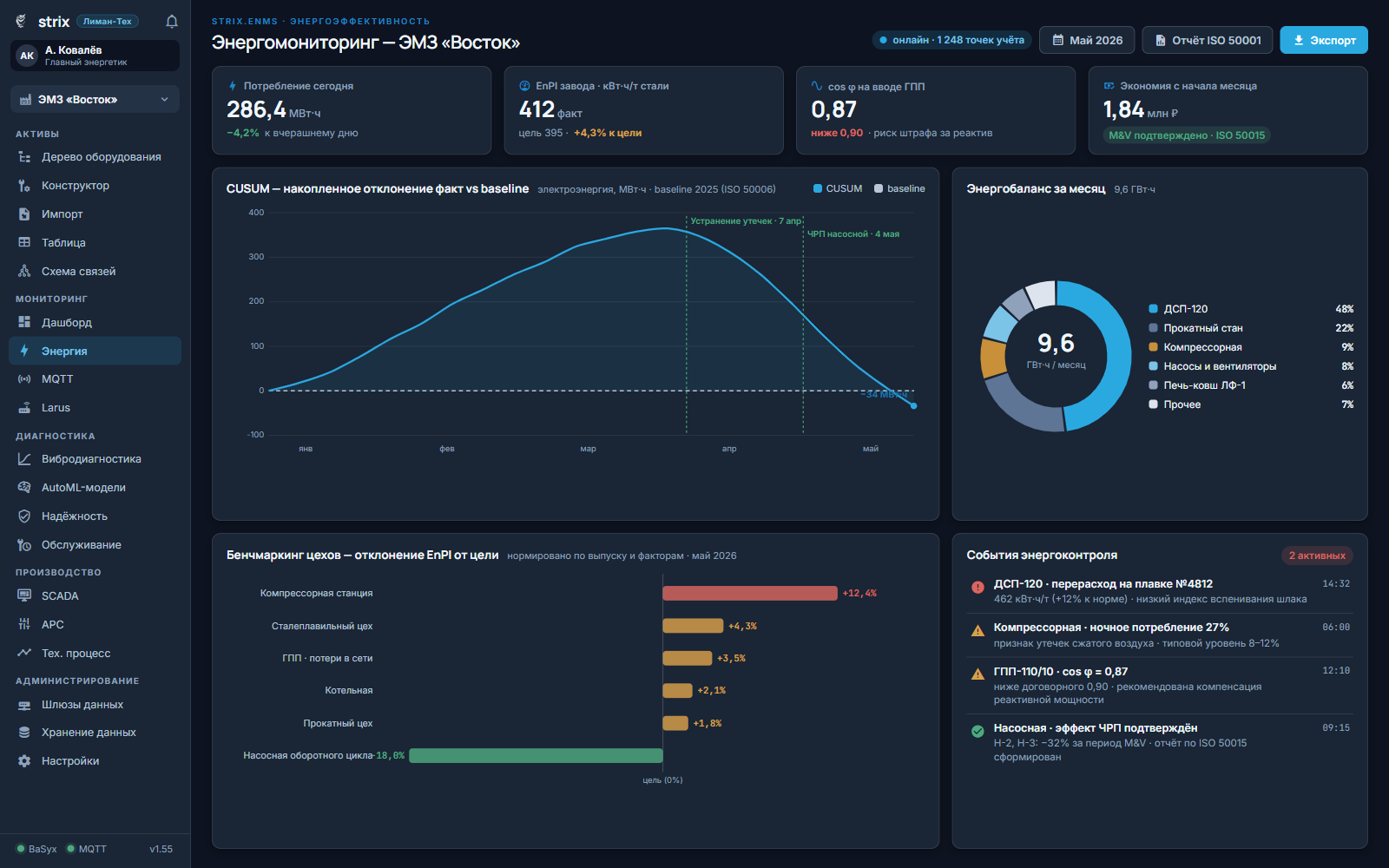
The energy engineer’s workstation in Strix
The interfaces are real, the data is for demonstration (a fictional plant). Swipe through: from the overall energy balance to savings verification.
How we verify savings
To get paid out of savings, you have to count them honestly. Five steps following the international methodology (ISO 50006 / ISO 50015) — from baseline to a legally meaningful calculation.
Baseline
An energy baseline — your reference consumption over 12 months. Savings are measured from it.
A fair comparison
Baselining — correcting for output volume, weather and product mix, so you compare like for like.
The target number
Specific consumption (EnPI) — kWh per tonne of product for each shop and stage.
The moment of savings
CUSUM — a cumulative "actual minus norm" chart: when savings started and how much has built up.
Verification
M&V — measurement & verification per ISO 50015: a legally meaningful savings calculation that pay-for-results is based on.
The terms on this page — in plain words
These same words will be in our report and contract — let them not be daunting.
Variable-frequency drive: it adjusts motor speed to the load — instead of running flat out behind a half-closed damper.
Specific energy consumption: how many kWh go into a tonne of product. The headline number we watch.
Energy baseline: reference consumption over 12 months — the point against which savings are measured.
A cumulative "actual minus norm" chart. It shows when savings (or overruns) started and how much has built up.
Measurement & verification: a methodology for honestly confirming savings per ISO 50015.
Energy performance contract: the contractor invests up front and recovers the money out of verified savings (261-FZ, ch. 5).
Commercial metering for settlement with the utility. It answers "how much to pay", not "where we lose it".
Power factor: the share of "useful" power in the network. The utility charges penalties for a low value.
Instrument-level metering — our foundation since 2018
For a large pipe plant we built an automated energy-resource monitoring and metering system — the instrument-level basis for managing the plant’s energy use. For the operator of high-voltage transmission networks we delivered electricity-metering projects (utility metering systems) at 35–750 kV substations across several regions of the country.
- Energy-resource metering for pipe production — delivered and signed off, 2018
- Electricity metering at 35–750 kV substations — projects 2018–2022
- Today analytics runs on top of the metering: baselines, deviations, savings verification
Three commercial models
From outright purchase to energy performance contracting, where you pay out of what you save.
CAPEX — purchase
You buy the equipment and software outright — all the savings are yours. Transparent and familiar; for critical-infrastructure sites — the only option.
ESCO — energy performance contracting
We and a financial partner invest up front, with recovery out of verified savings (261-FZ ch. 5; for public procurement — 44-FZ art. 108). For you — no up-front outlay.
MaaS — subscription
A monthly base fee + a percentage of verified savings (calculated per ISO 50015), over a 36-month term. The result risk is on us: no savings — no payment beyond the base.
Find out where you overpay for energy
Answer four questions — a manager will come back with specifics: where your typical losses are, the first step, and the order of savings. No obligations.
- We’ll estimate the potential against industry benchmarks
- We’ll show the order of savings and the payback period
- No outlay wanted — we’ll propose ESCO / MaaS
Request received. Thank you!
A manager will get in touch within one business day and show where plants of your profile usually hide their losses.
Ready for a detailed survey? Download the full questionnaire — filled in, it saves us both a week.
What people usually ask
We already have a utility metering system — why you?
A utility metering system is commercial metering for settlement with the utility: it answers "how much to pay". We build an analytics layer on top: specific-consumption baselines by shop and stage, detection of overruns, shop-to-shop comparison, savings verification. We do not duplicate your metering — we connect it as a data source.
What is the payback?
Organisational and metering measures — usually under 2 years, often 6–12 months. Technical ones (variable-frequency drives, reactive-power compensation, heat recovery) — 1–3 years. Under energy-performance models (ESCO / MaaS) — no up-front outlay: you pay out of the savings already achieved.
We have already had an energy audit — we got a report volume for the shelf.
A one-off audit is a "snapshot" at the moment of the survey. We provide continuous verification: the system constantly measures, baselines, and shows savings or overruns in real time (a cumulative savings chart — CUSUM), and runs a measures programme with execution tracking. An audit says "here is the potential"; our system says "here is the actual, verified result".
Do you install VFDs / modernise furnaces?
Power equipment (variable-frequency drives, capacitor banks, heat-recovery units) we select and supply as a subcontract. Our competence and responsibility — to measure, justify by calculation, manage and verify the effect. This protects you: we are interested in real savings, not in selling hardware.
What will you give the meltshop? The arc is controlled by the furnace regulator.
We do not interfere with the furnace control system — that is the safety and quality loop. Our layer is above it: we count the consumption of each heat, find "expensive" heats and their causes, monitor slag foaming via the electrical parameters of the arc, account for the effect of scrap and ladle-furnace preheating, and assess the heat-recovery potential. The result is an energy model of the shop, ready for an energy-performance contract.
Why do we need ISO 50001? We already have an energy department.
ISO 50001 is the energy-management system standard: instead of one-off campaigns — a continuous cycle of "measure → baseline → improve". Certification is increasingly required by holdings, export contracts and ESG reporting, and it also covers the obligations under the Russian energy-efficiency law (261-FZ) (energy declaration, energy-saving programme). Our system automates data collection and reporting — the energy department works on solutions, not on reconciling Excel.
Consumption data is sensitive information. Where is it stored?
The whole complex runs inside your perimeter, on your equipment (on-premise). No mandatory clouds or foreign services. The application software (LimanISU) is in the Unified Register of Russian Software. Access — under your information-security policies.
Why energy performance contracting rather than just selling the system?
We can sell it too (the CAPEX option) — the choice is yours. But the "pay from savings" model means the result risk is on us: no savings — no payment beyond the base. This is possible because our verification methodology (M&V per ISO 50015) gives a legally meaningful calculation of the actual savings. For energy efficiency, it is the most honest model.